Joe Healy Artist
My journey into the world of visual expression began not with a single moment of epiphany, but as a continuous thread woven into the fabric of my earliest childhood. Raised in an environment where my parents prioritized the presence of art supplies, I learned to see the world as a repository of potential long before I understood the formal language of composition. This foundational support was further galvanized by the vibrant, and expansive atmosphere of the New York City public school system. From elementary school through high school, I was the beneficiary of tireless educators who recognized my impulse to create and provided the encouragement necessary to turn a youthful interest into a lifelong vocation.
Now, with over forty years of practice behind me, my work remains an ongoing dialogue with the history of objects and the tactile nature of memory. While my methods and materials have shifted through the decades, the core of my practice has always been the art of the "assemblage"—the act of bringing disparate elements together to form a cohesive, albeit complex, new whole.
In the earliest stages of my career, my collages were rugged and industrial. I worked primarily with found objects, scouring the urban landscape for discarded metal and weathered wood. These pieces were explorations of weight, decay, and the structural integrity of the forgotten. I was drawn to the stories embedded in a rusted hinge or a splintered floorboard, seeking to honor the previous lives of these materials while forcing them into new, abstract configurations.
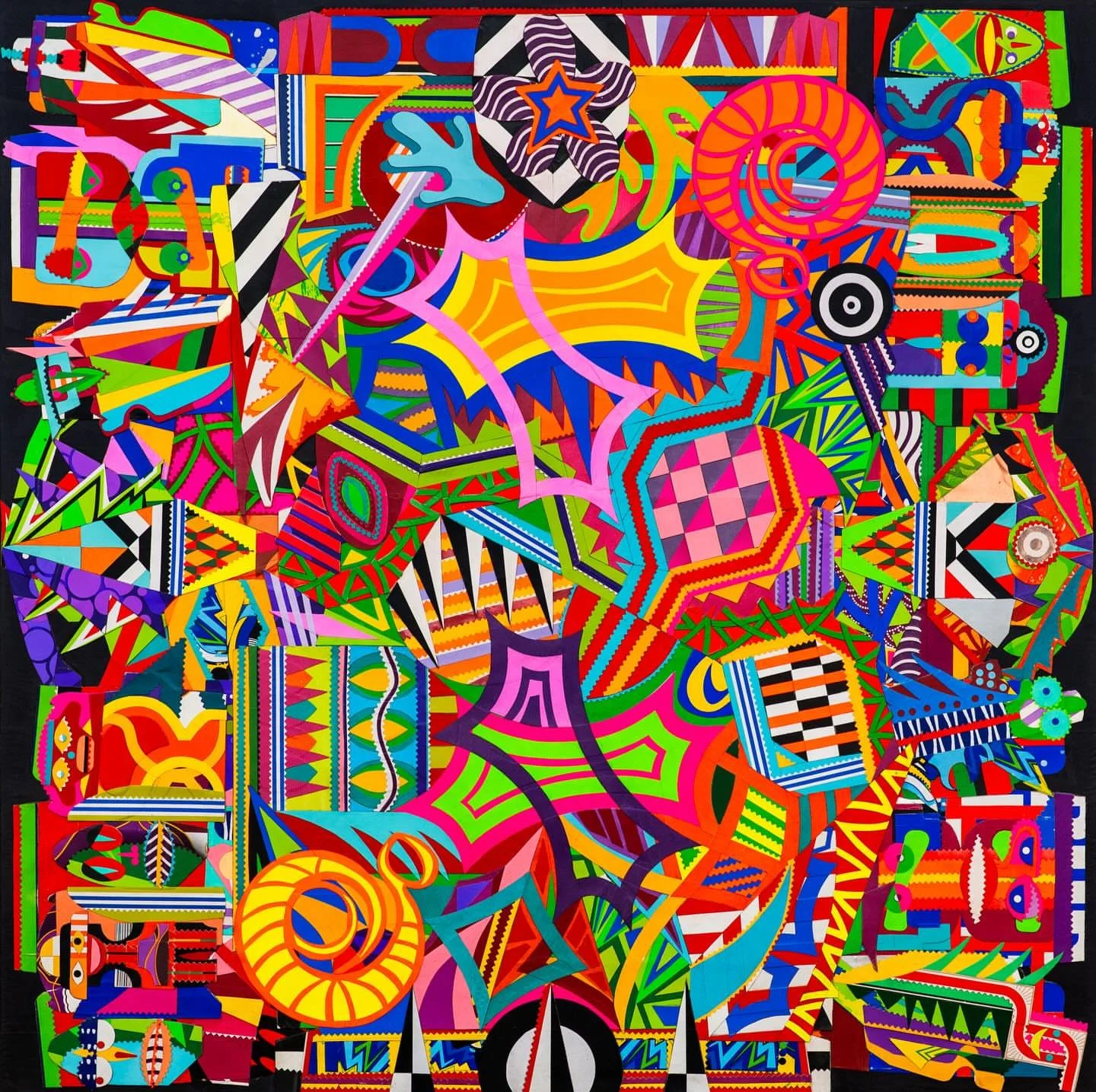
As my practice matured, I transitioned into a period of deep experimentation with paper and crayon, pushing the boundaries of what is traditionally considered a two-dimensional medium. During this era, I focused on building three-dimensional collages that defied the flat plane. By layering heavy-stock paper and applying dense, architectural strokes of crayon, I created relief works that occupied a space between drawing and sculpture. These pieces were about the transformation of the mundane; I wanted to prove that something as simple as a wax crayon could produce a work of profound depth and physical presence.
Today, my work has returned to a state of essentialism, focusing almost exclusively on upcycled paper. In an era of digital fleetingness and environmental excess, I find a quiet radicalism in the act of salvage. I collect remnants of the everyday—discarded envelopes, and scrap packaging—and meticulously reconfigure them into intricate compositions.
This current focus on upcycling is a culmination of my forty-year trajectory. It carries the structural lessons of my wood and metal period and the textural sensitivity of my three-dimensional paper works. For me, collage is not merely a technique; it is a philosophy of renewal. It is a way of processing the world’s fragments and proving that even the most overlooked scrap has a place in a larger, more beautiful narrative. Through these layers of history and pigment, I continue to explore the same curiosity that was first sparked in a New York City classroom decades ago: the belief that everything we need to create is already right here, waiting to be rediscovered.